Much ado about presidential oaths
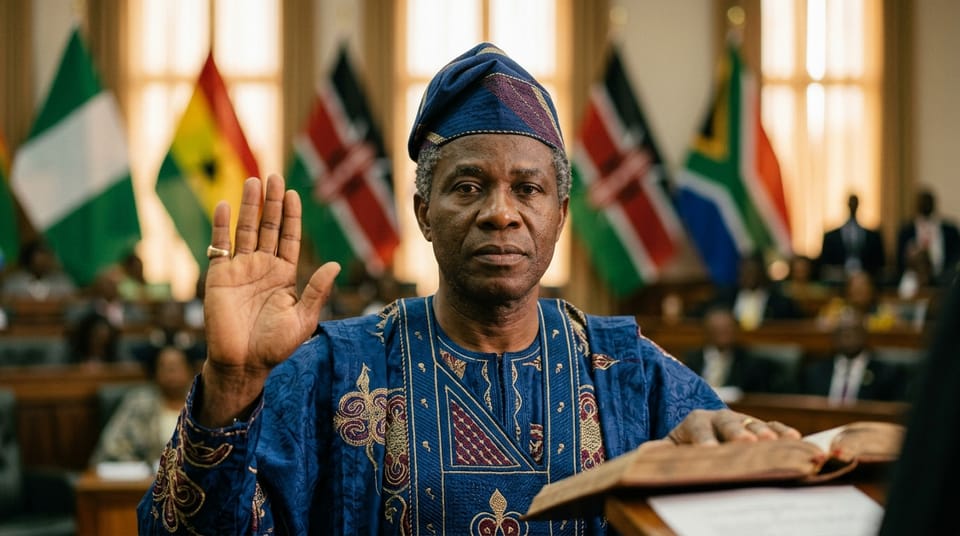
Amidst all the pomp and pageantry of swearing-in ceremonies, there’s one aspect that can easily be forgotten, yet exists as the cornerstone of the event: the oath of office.
Across the world, this act serves as the defining moment of every presidency, and I presume, for every president. Typically short and easy to miss. Presidential oaths mark a symbolic moment: the change from one President or Presidency to another. And they serve as a binding force between a leader and their citizens, becoming a source of the leader's constitutional powers and defining the leader's responsibilities to the People.
I enjoy watching these ceremonies, studying the structure and symbolism used by nations to project their power and the philosophy behind their constitutional order.
In 2024, as I listened to Senegal’s President Bassirou Diomaye Faye take his oath of office, I was struck by the last phrase, “to spare no effort for the realisation of African unity.” The beginning of the oath seemed to follow standard patterns. But this ending, felt different.
The President swore:
“Devant Dieu et devant la Nation sénégalaise, je jure de remplir fidèlement la charge de Président de la République du Sénégal, d'observer comme de faire observer scrupuleusement les dispositions de la Constitution et des lois, de consacrer toutes mes forces à défendre les institutions constitutionnelles, l'intégrité du territoire et l'indépendance nationale, de ne ménager enfin aucun effort pour la réalisation de l'unité africaine.”
English: “Before God and before the Senegalese Nation, I swear to faithfully fulfill the office of President of the Republic of Senegal, to observe and have scrupulously observed the provisions of the Constitution and of the laws, to devote all my strength to defending the constitutional institutions, the integrity of the territory and national independence, and to spare no effort for the realization of African unity.”
Most oaths start by referring to an overarching source of power, typically God and the sovereign people. Then the in-coming President swears to act in accordance with the constitution, as well as protect sacrosanct items like the unity of the nation, and the integrity of its borders. The oath may go on to some specifics unique to the nation, and depending on the historical context of the nation’s forming, end with a reference to God (if it wasn’t done in the beginning of the oath).
Yet, the drafters of the Senegalese constitution chose to make the president swear, not just to protect the nation and its own progress, but to work towards the realisation of African unity. And that got me thinking.
More so, because Leopold Senghor, a poet of great renown, an intellectual, and Senegal’s first president isn’t exactly a poster boy for pan-Africanism.
To simplify things, his story was complex.
President Senghor was seen by many as a stooge for France, who kept Senegal beholden to its old coloniser. Amongst his sins: campaigning for Senegal to stay in De Gaulle's Franco-African Community in 1958, and his critics accuse him of preserving the CFA Franc as Senegal's currency and retaining French military bases.
Senghor was simultaneously a founder of the Négritude movement that sought black consciousness among francophone Afro-descendants and pushed for independence of now former colonies.
In contrast, when we talk about independence struggles, people like Ghana’s Kwame Nkrumah, Burkina Faso’s Thomas Sankara, Nigeria's Obafemi Awolowo and Nnamdi Azikiwe, Egypt’s Gamal Abdel Nasser, and Tanzania’s Julius Nyerere would be mentioned before Senghor.
So why is it that Senghor's Senegal, unlike the others, makes an explicit commitment to African unity?
That moment and the questioning that followed, led me to studying presidential oaths across at least 40 African countries, looking for patterns and differences, all in a bid to develop a deeper understanding of the oaths presidents take.
There are some countries in the world that don't mandate for a presidential oath to be sworn. For example, The President of France, doesn’t swear one. In other cases, the Head of State might be a King or Queen. So they'd swear a different type of oath of allegiance.
In a similar manner, there are some countries I couldn’t find oaths for. Like Morocco and eSwatini, where there are kings. In other cases, the President of Ethiopia doesn’t hold the full powers of running the country, the Prime Minister does. And different countries have different approaches to designing their Presidential oaths of office. So, the Presidential oath doesn’t necessarily have the same impact or mean the same thing in every nation.
From the research, I found three broad themes:
- Faith is a strong component of the oaths. The countries whose oaths skip a reference to God are rare.
- There is a continuous pattern of referring to human rights, protecting citizens, national unity and territorial integrity.
- Presidential oaths take into account the unique context of the nation states, despite general assumptions are simply copy-paste documents influenced by colonial legacy
Presidential Oaths as a National Marker of Faith
Many presidential oaths are sworn in the name of God, in a manner that aligns with the religious beliefs of the majority in the state. For example, the Beninois and Gabonese presidents swear “Before God, ancestors (or their spirits) and the people” of their nations. Reflecting a plurality of faith, and using language that aligns with beliefs and practices in traditional African religions.
A clear marker of this plurality was shown during Brice Oligui Nguema’s ceremony of oaths. A traditional African priest was invited to perform rites publicly, after the constitutional oath was taken. Completing traditionally what had started through constitutional convention.
In Algeria, Comoros, Mauritania and Somalia, the oaths make explicit reference to Islam. The Algerian president swears “In the Name of Allah the most Merciful the most Compassionate.” Whereas some other nations like Niger refer to “God” as well as the “Holy Book,” despite having a muslim majority population. It would seem that each country designed its presidential oath according to the religious leanings of the majority of its citizens.
So what happens if a president doesn’t believe in God or the ancestors?
In Africa that never happens! You must believe.
In Benin, there was one situation where President Kérékou, while being sworn-in in 1996, chose not to swear by the “spirits of ancestors.” As a Christian, he was uncomfortable swearing by his ancestors. The day after, a debate followed regarding the constitutionality of his actions. The constitutional court decided on the matter and he was required to retake the oath of office, in full, acknowledging the ancestors.
Presidential Oaths as reaffirming human rights, national unity and territorial integrity
This might be a surprise to you, but many presidential oaths hold the president accountable for the unity of the nation, protecting territorial integrity (that is making sure the country stays as one without losing portions of it), and guaranteeing human rights.
These three promises form the mix and match for presidential oaths. Sometimes you get all three, other times two out of three. If you're unlucky, one of the three.
When a president swears to keep the nation one, keep its borders intact, and protect its people's rights, the oath becomes a legal promise the Republic can hold them to.
Despite what you might think of African governance or politics, these three promises are quite common. Of the oaths analysed, nine constitutions put all three commitments in the mouth of the president, and another nine bind the president to at least two of them.
Presidential Oaths reflecting a nation's unique history
It is often assumed that African constitutions are regurgitations of some external constitutional practice. From the analysis, there are four broad groups: Anglophone/Westminster lineage, Francophone civil-law lineage, Lusophone lineage and the Arabo-Islamic lineage.
Despite this, we still see reflections of each nation's specific context and history. In addition to Benin which was already mentioned, the Burundian constitution also reflects its own context by making an explicit reference to genocide reflecting the nation's unique history.
Before Almighty God, before the people of Burundi, sole possessors of national sovereignty, I, (state name), President of the Republic of Burundi, swear fidelity to the Charter of National Unity, to the Constitution of the Republic of Burundi and to the law, and commit to consecrating all of my powers to the defense of the higher interests of the nation, to assure national unity and the cohesion of the Burundi people, peace, and social justice. I commit myself to combatting every ideology and practice of genocide and of exclusion, to promote and to defend the individual and collective rights and freedoms of person and of citizen, and to safeguard the integrity and the independence of the Republic of Burundi
Presidential oaths are accompanied by pomp and pageantry. Sometimes we don't pay too much attention, sometimes we're excited about the new President. Regardless, the oaths give Presidents' the authority to lead, and the power to transform lives. They also give the people a promise to which they can hold their leaders accountable. Yet, many African leaders fall short of fulfilling their peoples dreams.
Swearing to uphold and abide the constitution, human rights and African unity, yet turning around to the exact opposite in reality. Like Senghor, many African leaders today are caught in a duality. Leveraging a rhetoric of hope, while governing in a manner that makes it seem they have other paymasters.
Learn more
- Anglophone/Westminster lineage: These constitutions tend to include markers such as “preserve, protect and defend the Constitution” (ultimately from the US Art. II oath via decolonisation-era drafting), “be faithful and bear true allegiance” (from the English oath of allegiance), “do right to all manner of people according to law, without fear or favour, affection or ill-will” (lifted verbatim from the English judicial oath of 1868, and found in Ghana, Malawi, Nigeria, Sierra Leone, Tanzania and Zambia), and the optional “So help me God” with a statutory affirmation alternative. The presence of a judicial-oath clause in presidential oaths is a distinctively anglophone-African feature: the president promises adjudicative impartiality, not only fidelity.
- Francophone civil-law lineage: A first-person “Je jure devant Dieu et devant le peuple ...” (or before the people alone: Burkina Faso, Congo, Côte d'Ivoire), followed by an enumerated list of commitments (constitution, territorial integrity, national unity, rights, public property), and very often closed by a self-imprecation clause: Benin, Chad, Niger, Mali, Guinea and Côte d'Ivoire all invite the rigour of the law, or withdrawal of the people's confidence, in case of perjury. Several use the royal/collective “We” (Chad, Niger, Togo), an echo of French ceremonial style. Pan-African unity clauses (Senegal, Mali, Niger) are unique to this family and date to the federalist aspirations of the early 1960s.
- Lusophone lineage: Angola, Cabo Verde, Guinea-Bissau, Mozambique and São Tomé and Príncipe all swear “on my honour”, with no deity invoked at all. This is the most consistently secular family on the continent, reflecting the Marxist-leaning constitutional moments of 1975 and the Portuguese republican tradition.
- Arabo-Islamic lineage: Algeria, Comoros, Egypt, Libya (draft), Mauritania, Somalia, Sudan and Tunisia swear by Allah (Algeria adds the basmala and fidelity to the November Revolution; Somalia adds the interests of religion itself). Morocco stands outside even this family, having no oath at all.
Member discussion